
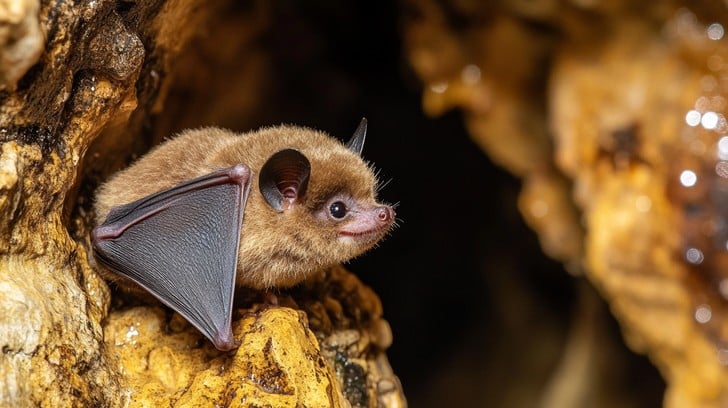
By Lori Porte
In our fall 2024 newsle er, we men oned an increased interest in bats, their benefits, and misunderstandings people have about them. We included a link to an ar cle from the US Fish and Wildlife Service en tled “Bats Are One of the Most Important Misunderstood Animals (BAOMIMA) (March 2022), and we also men oned our BLCOA Conserva on Project for 2025 being bat houses. Recently, the Tug Hill Commission provided webinars on topics of interest to northern New Yorkers. Joe Pasquini and I were fortunate to learn about the program and a end one en tled “Bats of New York: Challenges and Conservation (BoNY).
Over the years, we have o en arrived at the lake in the evening when we would observe many bats around our marina and flying overhead as we would make our way down the channel leading to the lake. It seems like we don’t see as many bats these days as we did in the past, and perhaps it is because there has been a significant decrease in the number of bats that exist here and worldwide. There are many misunderstandings about bats, and it is vital to recognize their value and how to protect them.
Misunderstandings and facts about bats
- A single bat can eat up to a 1000 insects in one night
- It is estimated “that bats eat enough pests to save more than $1 billion per year in crop damage and pescide costs in the United States corn industry alone.” Indeed across all agricultural produce on, bat insect consumption is estimated to save more than $3 billion per year! (BAOMIMA).
- Bats are not flying mice—in fact, they are not rodents all; unlike rodents who only live at most a couple years, bats can live up to 35 years, and they only have one pup per year.
- It’s highly unlikely a bat would get tangled in your hair.
- While there are vampire bats who thrive on blood, they are located in tropical and subtropical regions and none at all are found in the United States. Indeed, some bats are vegetarians, while others thrive on insects (BoNY).
- All bats are not carriers of disease (BoNY). Bats can get rabies like any other mammal, thus if you are bi en by a bat or another mammal, it is vital to be treated promptly. In the United States only 1-3 cases of rabies in humans is currently reported annually, unlike in the 1940s when the average was 30-50 cases per year. But that’s not because rabies isn’t out there. It is because of the post-exposure treatment that has prevented the disease from developing (CDC Press Release, 2019).
- Have you seen low-flying aircra over forested areas around the lake in recent years? You may have spo ed a plane dropping rabies vaccina ons to vaccinate the wildlife in the area (Jeffersoncountyny.gov, 2024). Thus efforts to control rabies is ongoing, and it is unlikely that you will encounter a rabid bat (NYS Department of Health, 2020).
- Another misnomer about bats is that they are blind. Bats actually have very good eyesight.
- Interes ngly bats are actually the only flying mammal (BoNY).
- Nine Species of Bats Live in New York
- Six species live in caves year-round, hiberna ng in the winter: li le brown, big brown, northern longeared, Indiana, tricolored, and small-footed. Though they are cave bats, somemes li le brown and big brown bats live in houses, barns, and other buildings.
- Three species of bats live in trees, leaf and rock piles, and they migrate south in the winter: hoary, silver-haired, and eastern red (BoNY).
Threats to bats
Bats have been significantly threatened world-wide in recent years. They have lost their habitats, been disturbed during hibernation, collided with wind turbines, and they have suffered from a terrible fungus called white nose syndrome (BoNY). White-nose syndrome is a fungal disease that kills hibernating bats. The disease is called “white-nose syndrome” because of the visible white fungus on bats’ muzzles, but the real damage is in the wings, which are needed for flying and retaining heat. Bats with white-nose syndrome may act strangely. Since bats are nocturnal animals, if they are seen flying around during the day in freezing temperatures, they may have the syndrome (National Park Service.org).
The first cases of white nose syndrome were noted at Howe Caverns in NY in 2006, most likely brought in by tourists from Europe or Asia. Due to the fungus, NY has experienced a 90% reductions in bat populations as the fungus has killed millions of bats. Two of the NY State species of bats are on the federally endangered list: Indiana and northern long eared. Li le brown bats have been recommended to be considered endangered, but all of the species have experienced drama c drops in population. On the positive side, it appears that big brown bats are becoming resistant to the fungus. Bats can shed the white nose fungus in the spring as long as their wings are healthy enough for them to get to food sources and they can feed themselves (BoNY).
Things you can do to help bats
- Minimize the use of insecticides
- Maintain suitable roos ng and foraging habitats
- Do not enter caves during the hiberna on season (waking a hiberna ng bat could result in the bat dying). Always disinfect shoes before entering caves.
- If you need to remove a tree that has been a host to migrating bats, remove it in the winter.
- If you have a bat or bats that need to be removed from an area or a structure, have trained handlers safely proceed with the process.
- Have-a-Heart traps are preferred, and it is recommended to avoid sticky traps (BoNY).
What about bat houses?
- Bat houses can provide a welcome habitat for bats.
- Bat houses need to be placed in open spaces on 12 to 20-foot poles or on the side or roof of a building where there is a clear flight path and predators cannot reach them.
- Bat houses should have multiple, tight-fitting, rough-textured roosting areas.
- The houses should have vents to allow air to circulate and prevent overheating.
- Rough landing pads should be provided below the entrance.
- Cedar, redwood, and other rough woods make good choices for bat houses.
- The seams should be sealed to prevent water from entering.
- Predator baffles could be added to a pole mount.
- Once they are living in the bat house, minimize disturbances in the area (AI Overview, “How to Succeed with a Bat House,” 2025).
References:
“Annual Oral Rabies Vaccine Bait Program to Begin,” July 24, 2024, Jeffersoncountyny.gov. h ps://archive.cdc.gov/www_cdc_gov/media/ releases/2019/p0611-bats-rabies.html h ps://www.fws.gov/story/bats-are-one-mostimportant-misunderstood-animals h ps://tughill.org/wp-content/uploads/2025/02/ Bat_presenta on_2024.pdf h ps://www.health.ny.gov/diseases/ communicable/zoonoses/rabies/ The Passing of Lifelong Bu erfield L